Share US 90A Transit Corridor Study on FacebookShare US 90A Transit Corridor Study on X (formerly Twitter)Share US 90A Transit Corridor Study on LinkedinEmail US 90A Transit Corridor Study link
This map shows the US 90A Transit Study's recommendation: a three-phased approach for implementing High-Capacity Transit within the US 90A Corridor. The first phase begins at the Fannin South Park and Ride and extends westward into Fort Bend County along US 90A and the Fort Bend County Toll Road. A second phase would extend it across the Brazos River to the Grand Parkway, where significant development is anticipated to occur. In the longer term, a branch would continue along US 90A through Stafford to connect to IH-69/US 59.
The Houston-Galveston Area Council (H-GAC), in partnership with the Gulf Coast Rail District (GCRD), conducted a study to develop feasible and reasonable transit alternative(s) for the US 90A Highway corridor.
The US 90A Highway corridor parallels the Union Pacific Railroad (UPRR) Glidden Subdivision and passes through some of Fort Bend County’s most significant and growing urban developments, including the cities of Missouri City, Stafford, Sugarland, Richmond, and Rosenberg, as well as communities in Southwest Houston. At the corridor’s eastern end is the Texas Medical Center, a major employment center that is the destination for many Fort Bend County commuters. The US 90A Highway itself does not currently have any transit priority infrastructure, even though it provides a key connection between Fort Bend County and the Texas Medical Center. Furthermore, despite several studies considering commuter rail along the UPRR Glidden Subdivision, UPRR has maintained that commuter rail along its right-of-way is not part of its business model and is therefore not a feasible transit solution for this corridor.
The purpose of this study was to assess the technological and economic feasibility of establishing and operating efficient transit service along this corridor, using modal options including light rail transit and bus rapid transit, that could have significant benefits to mobility within the region. The goal of this study was to generate feasible and reasonable transit alternative(s) for this corridor that can be advanced into more detailed study and analysis, with an eye towards implementation.
This map shows the US 90A Transit Study's recommendation: a three-phased approach for implementing High-Capacity Transit within the US 90A Corridor. The first phase begins at the Fannin South Park and Ride and extends westward into Fort Bend County along US 90A and the Fort Bend County Toll Road. A second phase would extend it across the Brazos River to the Grand Parkway, where significant development is anticipated to occur. In the longer term, a branch would continue along US 90A through Stafford to connect to IH-69/US 59.
The Houston-Galveston Area Council (H-GAC), in partnership with the Gulf Coast Rail District (GCRD), conducted a study to develop feasible and reasonable transit alternative(s) for the US 90A Highway corridor.
The US 90A Highway corridor parallels the Union Pacific Railroad (UPRR) Glidden Subdivision and passes through some of Fort Bend County’s most significant and growing urban developments, including the cities of Missouri City, Stafford, Sugarland, Richmond, and Rosenberg, as well as communities in Southwest Houston. At the corridor’s eastern end is the Texas Medical Center, a major employment center that is the destination for many Fort Bend County commuters. The US 90A Highway itself does not currently have any transit priority infrastructure, even though it provides a key connection between Fort Bend County and the Texas Medical Center. Furthermore, despite several studies considering commuter rail along the UPRR Glidden Subdivision, UPRR has maintained that commuter rail along its right-of-way is not part of its business model and is therefore not a feasible transit solution for this corridor.
The purpose of this study was to assess the technological and economic feasibility of establishing and operating efficient transit service along this corridor, using modal options including light rail transit and bus rapid transit, that could have significant benefits to mobility within the region. The goal of this study was to generate feasible and reasonable transit alternative(s) for this corridor that can be advanced into more detailed study and analysis, with an eye towards implementation.
Share US 90A Corridor Transit Study - Survey on FacebookShare US 90A Corridor Transit Study - Survey on X (formerly Twitter)Share US 90A Corridor Transit Study - Survey on LinkedinEmail US 90A Corridor Transit Study - Survey link


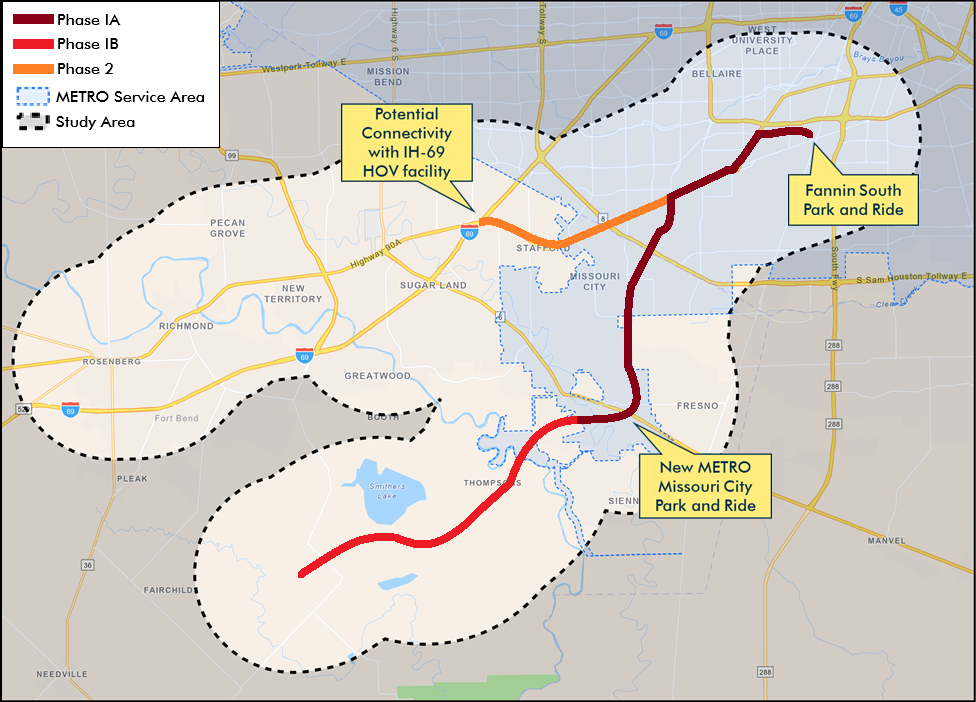 This map shows the US 90A Transit Study's recommendation: a three-phased approach for implementing High-Capacity Transit within the US 90A Corridor. The first phase begins at the Fannin South Park and Ride and extends westward into Fort Bend County along US 90A and the Fort Bend County Toll Road. A second phase would extend it across the Brazos River to the Grand Parkway, where significant development is anticipated to occur. In the longer term, a branch would continue along US 90A through Stafford to connect to IH-69/US 59.